Robert Schumann
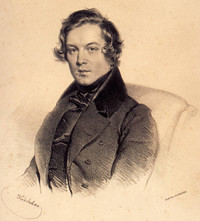
Robert Schumann (German: [ˈʁoːbɛʁt ˈʃuːman]; 8 June 1810 – 29 July 1856) was a German composer, pianist, and music critic of the early Romantic era. He composed in all the main musical genres of the time, writing for solo piano, voice and piano, chamber groups, orchestra, choir and the opera. His works typified the spirit of the Romantic era in German music.
Schumann was born in Zwickau, Saxony, to an affluent middle-class family with no musical connections, and was initially unsure whether to pursue a career as a lawyer or to make a living as a pianist-composer. He studied law at the universities of Leipzig and Heidelberg but his main interests were music and Romantic literature. From 1829 he was a student of the piano teacher Friedrich Wieck, but his hopes for a career as a virtuoso pianist were frustrated by a worsening problem with his right hand, and he concentrated on composition. His early works were mainly piano pieces, including the large-scale Carnaval, Fantasiestücke (Fantasy Pieces), Kreisleriana and Kinderszenen (Scenes from Childhood) (1834–1838). He was a co-founder of the Neue Zeitschrift für Musik (New Musical Journal) in 1834 and edited it for ten years. In his writing for the journal and in his music he distinguished between two contrasting aspects of his personality, dubbing these alter egos "Florestan" for his impetuous self and "Eusebius" for his gentle poetic side.
Despite the bitter opposition of Wieck, who did not regard his pupil as a suitable husband for his daughter, Schumann married Wieck's daughter Clara in 1840. In the years immediately following their wedding Schumann composed prolifically, writing, first, songs and song‐cycles including Frauenliebe und Leben ("Woman's Love and Life") and Dichterliebe ("Poet's Love"). He turned his attention to orchestral music in 1841, completing the first of his four symphonies. In the following year he concentrated on chamber music, writing three string quartets, a Piano Quintet and a Piano Quartet. During the rest of the 1840s, between bouts of mental and physical ill health, he composed a variety of piano and other pieces and went with his wife on concert tours in Europe. His only opera, Genoveva (1850), was not a success and has seldom been staged since.
Schumann and his family moved to Düsseldorf in 1850 in the hope that his appointment as the city's director of music would provide financial security, but his shyness and mental instability made it difficult for him to work with his orchestra and he had to resign after three years. In 1853 the Schumanns met the twenty-year-old Johannes Brahms, whom Schumann praised in an article in the Neue Zeitschrift für Musik. The following year Schumann's always-precarious mental health deteriorated gravely. He threw himself into the River Rhine but was rescued and taken to a private sanatorium near Bonn, where he lived for more than two years, dying there at the age of 46.
During his lifetime Schumann was recognised for his piano music – often subtly programmatic – and his songs. His other works were less generally admired, and for many years there was a widespread belief that those from his later years lacked the inspiration of his early music. More recently this view has been less prevalent, but it is still his piano works and songs from the 1830s and 1840s on which his reputation is primarily based. He had considerable influence in the nineteenth century and beyond. In the German-speaking world the composers Gustav Mahler, Richard Strauss, Arnold Schoenberg and more recently Wolfgang Rihm have been inspired by his music, as were French composers such as Georges Bizet, Gabriel Fauré, Claude Debussy and Maurice Ravel. Schumann was a major influence on the Russian school of composers, including Anton Rubinstein and Pyotr Ilyich Tchaikovsky.
Relaxing Piano
- 2025-10-09T00:00:00.000000Z
Relaxing Cello
- 2025-08-25T00:00:00.000000Z
Similar Artists